About Rotary Vacuum Evaporator Diagonal Condenser Model
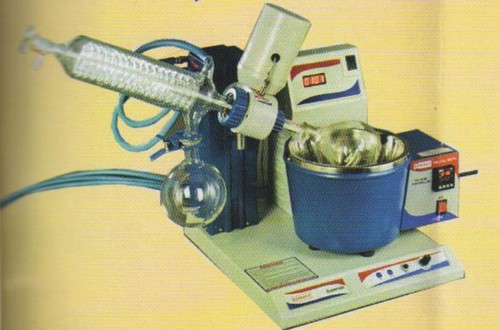
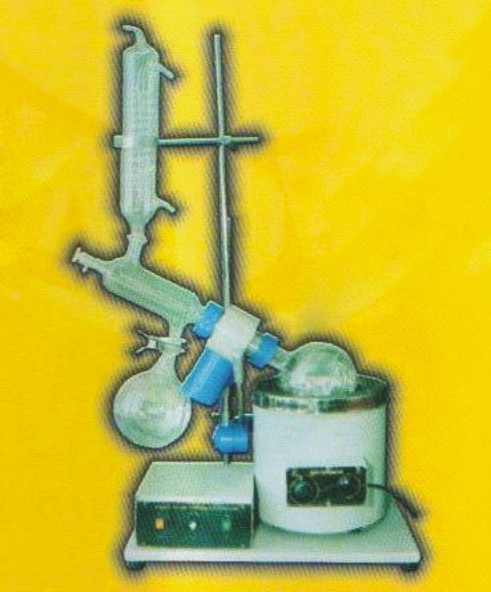
Rotary Vacuum Evaporator Diagonal Condenser Model No. SSI/61
Provided with LED display for R.P.M control, motorized lift arrangement for glass assembly control upto 100mm, lifting up/down through soft touch switches, digital temperature controlled water/oil bath from ambient +5 deg C to 180 deg C cap 4.5 ltr, geared drive unit offers smooth speed rotation from 20 to 180 R.P.M water circulation and vacuum inlet assembly is fitted at the rear of the lift to reduce the pressure at glass joints of condenser. Diagonal double coiled condenser pear (Kjeldhal) shaped evaporating flask cap 800ml, Receiving flask cap one ltr fitted with a ball joint, feeding tube, vapour path tube, provided with rubber tube, pressure tube, seal clips, and spring a complete working unit.
Replacement part for (Diagonal Condenser) SSI/61
| SSI/61/01 | Condenser double coiled with S-35 cup. With three opening for vacuum and cooling |
| SSI/61/02 | Vapour path tube B-24, B-29 |
| SSI/61/03 | Gasket seal for vapour tube |
| SSI/61/04 | Gasket seal for special chemicals |
| SSI/61/05 | Receiving flask with S-35 cup (socket) joint capacity 1000ml |
| SSI/61/06 | Evaporating flask kjeldhal cap. 800ml B-24 |
| SSI/61/07 | Evaporating flask kjeldhal cap. 500ml B-24 |
| SSI/61/08 | Evaporating flask kjeldhal cap. 300ml B-24 |
| SSI/61/09 | Evaporating flask kjeldhal cap. 100ml B-24 |
| SSI/61/10 | Tension spring to hold condenser |
| SSI/61/11 | Standard joint clip B-24 |
| SSI/61/12 | Ball joint clip with screw lock |
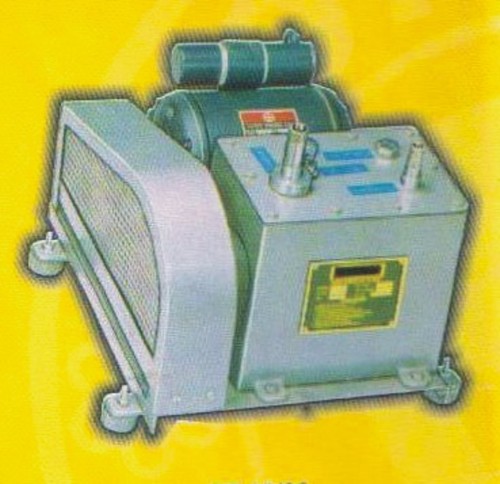
| SSI/61/13 | Suitable oil free vacuum pump for rotary evaporator with vacuum gauge & regulator |
| SSI/61/14 | Glass safety trap |
This rotary vacuum evaporator is engineered for consistent and accurate evaporation, achieving up to 2 liters per hour. The combination of borosilicate glassware, PTFE seals, and a precisely regulated heating bath gives users confidence in both performance and safety. Powerful vacuum coupling supports efficient solvent recovery, making it suitable for demanding laboratory environments where purity and yield matter.
User-Friendly Control with Enhanced SafetyWith a manual control knob, users can finetune the rotation speed and operational parameters for diverse applications. The integrated overheat and overload protection ensures safe operation, while the design meets CE certification standards. Its clear control panel and semi-automatic functionality simplify workflow, improving reliability and ease of use in routine and advanced laboratory tasks.
FAQs of Rotary Vacuum Evaporator Diagonal Condenser Model :
Q: How does the Rotary Vacuum Evaporator Diagonal Condenser Model work for sample concentration?
A: This device utilizes controlled rotation and heated water or oil baths to evaporate solvents under reduced pressure (vacuum). The diagonal condenser design enhances the recovery of evaporated solvents for efficient concentration or purification of samples.
Q: What safety features are present in this evaporator model?
A: It is equipped with overheat and overload protection mechanisms, ensuring safe operation during prolonged use. Additionally, the PTFE-coated stainless steel bath and borosilicate glassware enhance safety and chemical resistance.
Q: When should I use water versus oil in the heating bath?
A: Use water when temperatures up to 100C are sufficient for evaporation. For higher temperature requirements (up to 180C), oil is recommended to ensure consistent heating and efficient solvent evaporation.
Q: Where is this rotary evaporator best installed?
A: The unit is designed for benchtop installation in laboratory settings, such as research facilities, educational institutions, and industrial labs that require controlled evaporation and solvent recovery processes.
Q: What cooling water flow is required for operation?
A: A cooling water supply with a flow rate between 2 to 5 liters per minute is necessary to effectively condense vapors during operation, ensuring optimal performance and protection of the condenser unit.
Q: How does using borosilicate glass in the receiving and evaporation flasks benefit my experiments?
A: Borosilicate glass provides excellent chemical resistance and thermal stability, minimizing the risk of sample contamination and allowing the instrument to reliably process a wide range of solvents at varying temperatures.
Q: What are the main advantages of this rotary vacuum evaporator model?
A: This model offers highly efficient evaporation with precise manual control, robust safety features, high chemical resistance, and compliance with CE standards. It supports evaporation rates up to 2 L/h, making it ideal for laboratory applications requiring accuracy and reliability.








 Send Inquiry

 Send Inquiry