About Sieves
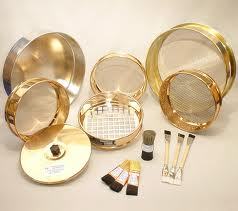
ST SIEVES 8" (20 cm) dia brass frame stainless steel mesh | B.S.S No. | ASTM No | I.S.S. No. | M.M./Micron | | 4 | 5 | 480 | 4.75 mm | | 5 | 6 | 340 | 3.35 mm | | 6 | 7 | 280 | 2.80 mm | | 7 | 8 | 240 | 2.36 mm | | 8 | 10 | 200 | 2.00 mm | | 10 | 12 | 170 | 1.70 mm | | 12 | 14 | 140 | 1.40 mm | | 14 | 16 | 120 | 1.18 mm | | 16 | 18 | 100 | 1.00 mm | | 18 | 20 | 85 | 850 micron | | 22 | 25 | 70 | 710 micron | | 25 | 30 | 60 | 600 micron | | 30 | 35 | 50 | 500 micron | | 36 | 40 | 40 | 425 micron | | 44 | 45 | 35 | 355 micron | | 52 | 50 | 30 | 300 micron | | 60 | 60 | 25 | 250 micron | | 72 | 70 | 20 | 212 micron | | 85 | 80 | 18 | 180 micron | | 100 | 100 | 15 | 150 micron | | 120 | 120 | 12 | 125 micron | | 150 | 140 | 10 | 106 micron | | 170 | 170 | 9 | 90 micron | | 200 | 200 | 8 | 75 micron | | 240 | 230 | 7 | 63 micron | | 300 | 270 | 6 | 53 micron | | 325 | 300 | 5 | 45 micron | | 350 | 325 | 4 | 44 micron | | 400 | 380 | 3 | 40 micron | |
Precision Mesh SizingOur sieves offer an extensive mesh size range from 36 micron to 2 mm, providing exact particle separation and classification for laboratory analyses. This versatility enables accurate screening, whether you work with fine powders or larger granules, ensuring consistent test results across various research applications.
Durable Stainless Steel ConstructionManufactured with premium 304 grade stainless steel, the sieve frames are robust, resist corrosion, and are mirror polished for effortless cleaning. The circular shape enhances stability and handling during use, while the autoclavable design guarantees thorough sterilization for repeated laboratory use.
Compliance and Quality AssuranceEach sieve adheres strictly to ASTM E11 and IS standards, ensuring highly reliable and reproducible outcomes. The circular mesh openings support standardized laboratory procedures, safeguarding the consistency of your sample testing in research, education, and industrial settings.
FAQs of Sieves:
Q: How should I clean and sterilize these laboratory sieves?
A: These sieves are both washable and autoclavable. You can clean them by rinsing with mild detergent and water, then autoclaving at standard laboratory settings for complete sterilization, ensuring theyre ready for repeated sample analyses.
Q: What is the recommended usage for sieves with mesh sizes ranging from 36 micron to 2 mm?
A: These sieves are ideal for precise particle separation in laboratory sample testing. They can be used for evaluating powders, granules, and other materials where mesh size accuracy is crucial for research, quality control, or educational work.
Q: When should I opt for stainless steel 304 grade sieves with a mirror polished finish?
A: Choose these sieves when you require corrosion-resistant, durable equipment that is easy to clean and maintain. The mirror polish finish helps to prevent sample contamination and supports frequent use in lab environments requiring hygienic procedures.
Q: Where are these laboratory sieves typically utilized?
A: They are commonly used in laboratories across research institutions, universities, industrial quality control labs, and environments following ASTM E11 and IS compliance standards for particle size analysis and classification.
Q: What is the process for using these sieves manually?
A: To use manually, place the desired quantity of laboratory sample onto the mesh, fit the sieve into a stack if required, and shake or tap gently to allow particle separation. The manual operation offers precise control over sample handling, ensuring accurate results.
Q: What are the benefits of using circular mesh sieves with standardized compliance?
A: The main advantages include highly efficient and accurate sample separation, durability due to stainless steel construction, and reproducibility in accordance with ASTM E11 and IS standardscrucial for professional laboratory testing and analyses.
Q: How accurately can these laboratory sieves classify particle sizes?
A: With 100%% accuracy, these sieves ensure consistent separation of particles according to the specific mesh size, making them suitable for detailed laboratory sample analysis and standardized procedures.








 Send Inquiry

 Send Inquiry