About VERNIER MICROSCOPE
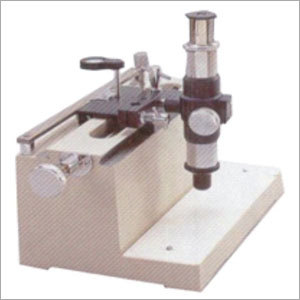
Also called six position microscope since it can be used along all six directions of the 3D axes. On heavy, cast iron base. Telescope fitted with achromatic objective and Ramsden eyepiece. Scale graduated in 0.5mm with a vernier LC of .02mm.High Precision Measurement CapabilityDesigned for meticulous measurement tasks, the Vernier Microscope features a vernier scale with a least count of 0.01 mm. This lets users make reliable and precise measurements of extremely small distances and angles, suitable for professional laboratory environments and educational use alike.
Robust and Stable ConstructionThe microscope is constructed with a heavy cast iron base, complemented by brass and stainless steel fittings. Three leveling screws ensure stability during measurement, and an epoxy powder coating offers protection and longevity, even under frequent laboratory usage.
Versatile Stage and Optical SystemWith its rotatable table featuring a degree scale and a detachable optical tube, the Vernier Microscope excels in versatility. The stage movement is finely controlled up to 20 mm using the Rack and Pinion mechanism, allowing precise alignment and focus on specimens.
FAQs of VERNIER MICROSCOPE:
Q: How do you use the Vernier Microscope for measuring small distances?
A: To measure small distances, position the specimen on the microscope stage, focus using the coarse and fine adjustment screws, and utilize the vernier movement for precise stage alignment. The least count of 0.01 mm allows for highly accurate readings directly from the scales.
Q: What are the main components included with the Vernier Microscope?
A: Key components include the main scale, vernier scale, microscope tube with 10X eyepiece and 2X objective, coarse and fine focusing mechanism, heavy cast iron base, brass and stainless steel fittings, rotatable table with degree scale, and protective foam packaging.
Q: When is the Vernier Microscope most beneficial in a laboratory setting?
A: It is particularly beneficial when high precision is required for tasks such as measuring small dimensions, angular positions, or calibrating instruments, ensuring that experiments yield reliable and reproducible results.
Q: Where is the Vernier Microscope commonly used?
A: This instrument is widely used in educational and research laboratories, materials testing facilities, and quality control environments across India, where meticulous measurement of micro-intervals is essential.
Q: What process is involved in focusing and adjusting the stage?
A: Initial focusing is achieved using coarse adjustment. Fine tuning is then performed with the fine adjustment screw. Stage movement up to 20 mm with vernier precision is managed by the rack and pinion mechanism for accurate sample positioning.
Q: What are the benefits of the heavy cast iron base and epoxy coating?
A: The cast iron base provides excellent stability, minimizing vibrations during precise measurements, while the epoxy powder coating ensures durability and protection against laboratory wear and corrosion.








 Send Inquiry

 Send Inquiry