About Slip & creep measurement apparatus
Slip & creep measurement apparatus
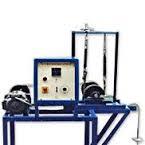
This apparatus is useful for measurement of power transmitted for various input power conditions with varied belt tension. Belt slip or creep also can be measured. The apparatus consists of a variable speed D.C. Motor, driving pulley and driven pulley of equal diameters. The pulleys are mounted on input shaft (motor shaft) and output shaft. The driven pulley can slide on the base only with bearing block to change the initial tension in belt. Brake drum is mounted on the output shaft, which helps to measure power output. The motor speed is varied by Thyristor Control D.C. Drive. A double channel digital speed indicator indicates driving and driven pulley speeds. With the help of Stroboscope (not in the scope of supply) it is possible to demonstrate the slip of belt on driving and driven pulley.
Experiments
- To measure co-efficient of friction between pulley material and different belt materials.
- To measure power transmitted with varied belt tension.
- To measure percentage slip at fixed belt tension by varying load on the Brake drum and plot the graph of (T1- T2) v/s percentage slip i.e. "Slip Characteristics" Finding a Creep Zone from graph.
- To measure belt slip speed and observe the limiting value of load at constant speed when the slip just starts
- To study creep of belt
Utilities Required
- Electricity 0.5 kW, 220 V, Single Phase
- Stroboscope
Precision and Efficiency for Laboratory TestingThe SCMA-100 offers unmatched efficiency and accuracy in measuring the slip and creep of materials, ideal for laboratory applications. With its highly efficient manual controls and overload safety features, this apparatus ensures reliable test results every time. Its powder-coated surface finish and sturdy framing guarantee long-lasting performance, even with continual use.
Customizable and Versatile Testing CapabilitiesTest specimens with thicknesses between 1 mm and 10 mm are easily accommodated, with options for customization on request. The equipments manual lever control lets operators conduct tests seamlessly, while the clear measuring dials present slip and creep data accurately. Its flexible design meets diverse laboratory needs, while maintaining user safety and comfort,
Engineered for User Safety and Low MaintenanceSafety is integral to the SCMA-100s design. Its overload protection prevents operator or equipment damage. Constructed primarily from stainless steel and mild steel, it is both durable and easy to maintain. The apparatus is designed for indoor, floor-mounted installation and arrives securely packaged in a wooden box, ready for use.
FAQs of Slip & creep measurement apparatus:
Q: How do I calibrate the Slip & Creep Measurement Apparatus?
A: The SCMA-100 is factory calibrated for immediate use and does not require additional calibration before operation. Routine checks as per the supplied guidelines will ensure continued measurement accuracy.
Q: What specimens can be tested with this apparatus?
A: The apparatus is suitable for standard specimens with a thickness range of 1 mm to 10 mm. Custom-sized holders can be provided upon request, expanding its usability for various test samples.
Q: Where should the SCMA-100 be installed?
A: This equipment is intended for indoor laboratory use and is best installed on a flat floor surface. Proper installation is essential for consistent and reliable measurements.
Q: What is the process for conducting a test using this apparatus?
A: To test, secure your specimen in the holders, set the measurement dials to zero, and use the manual lever to apply load, observing slip and creep values on the respective dials. Follow the included operating instructions for best results.
Q: What safety features are included in the SCMA-100?
A: The apparatus is equipped with overload protection to safeguard both the user and the device during operation. Its robust construction and powder-coating also enhance user safety by minimizing wear and exposure.
Q: What are the primary benefits of using this apparatus in a laboratory?
A: Benefits include highly efficient and accurate measurement, low maintenance needs, customizable specimen holders, overload safety, and reliable operation in controlled indoor environments. The design ensures precise and repeatable test results.










 Send Inquiry

 Send Inquiry