About WHETSTONE BRIDGE
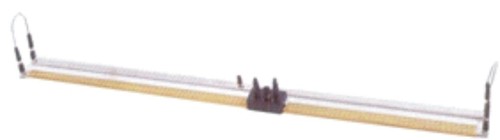
A meter rule fixed on a metal base has a constantan wire running across its length. Sliding jockey with two tapping keys, one at each end, moves over the wire. 4mm socket terminals for electrical connections. With instructions. Precision Measurement for LaboratoriesEngineered for physics and electrical engineering labs, this Wheatstone Bridge enables precise resistance measurement across a broad range, thanks to three selectable ratio arms. Its high accuracy and robust construction make it ideal for experimental setups and education, supporting repeatable and reliable results.
Stable and Reliable ConstructionUsing manganin wire for resistance elements and brass posts for connections, the bridge guarantees stable readings and exceptional longevity. The resilient metallic fittings and durable black base ensure the device withstands frequent lab use while maintaining its measurement integrity.
Sensitive Galvanometer for Enhanced DetectionA built-in galvanometer with 1 microampere sensitivity per division allows detection of minute electrical currents, improving measurement accuracy. This sensitive instrument is fundamental for balancing the bridge and achieving precise resistance results.
FAQs of WHETSTONE BRIDGE:
Q: How does the Wheatstone Bridge provide high accuracy in resistance measurement?
A: The Wheatstone Bridge achieves high accuracy (up to 0.2%) due to its use of stable manganin wire resistors, sensitive galvanometer, precise ratio arms, and robust copper connections, allowing minimization of measurement errors during laboratory experiments.
Q: What are the benefits of having three ratio arms (1:1, 1:10, 1:100) on this Wheatstone Bridge?
A: Three ratio arms enable flexible adjustment of measurement range and resolution, making the bridge suitable for both low and high resistance measurements and enhancing its versatility in physics and electrical engineering labs.
Q: When should you use this Wheatstone Bridge in a laboratory setting?
A: The Wheatstone Bridge should be used during experiments requiring accurate resistance determination, calibration of other instruments, or when investigating electrical properties of materials within a voltage range of up to 6V DC and temperatures from 0C to 50C.
Q: Where is this Wheatstone Bridge typically deployed?
A: This Wheatstone Bridge is commonly found in educational institutions, research laboratories, and physics or electrical engineering departments throughout India for teaching, experimentation, and instrument calibration.
Q: What is the process for using the Wheatstone Bridge circuit?
A: To use the Wheatstone Bridge, connect the unknown resistor, adjust the ratio arms, and balance the circuit using the sensitive galvanometer until no deflection is observed, which indicates equilibrium and allows calculation of the unknown resistance.
Q: How does the manganin wire improve measurement stability in this instrument?
A: Manganin wire offers low temperature coefficient and high long-term stability, ensuring the resistance values remain consistent and precise across the bridges operating temperature range, thereby improving the reliability of results.
Q: What advantage does the robust construction offer in laboratory use?
A: The bridges sturdy metallic fittings, durable black base, and brass binding posts protect against mechanical damage, ensuring portability, longevity, and dependable performance even in busy laboratory environments.









 Send Inquiry

 Send Inquiry