About Research Co-Axial Microscopes
Binocular & Trinocular Research Co-Axial Microscopes Model
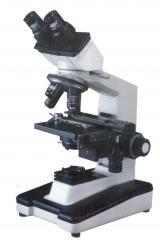
121 (a): - Binocular inclined co-axial microscope
Biological microscopes with its standard features are designed for medical school applications. This system is for use in laboratories, clinics, research facilities and medical schools. The modern and ergonomic designs distinguish itself from the others. Its affordable price and excellent quality give you the best value for your money. Binocular head can be rotated 3600 & has constant tube length with graduated interpupillary adjustment from 55 mm to 75 mm
Co-axial coarse & fine focusing
Co-axial coarse & fine focussing mechanism on ball bearing guide ways
Graduation knob with 1 division = 0.002 mm
Binocular & Trinocular Research Co- Axial Microscopes
Extra large size base, which supports the robust arm, has a special grade plastic top to provide comfortable hand rest for ease of operation.
Revolving Nosepiece: - Quadruple nosepiece on ball bearing precisely par focal par centered.
Condenser: - Sub stage condenser NA 1.25 with iris diaphragm and daylight blue glass filter.
Mechanical Stage: - Built in ball bearning mechanical stage provides a travel range of 76 mmx50 mm in the X and Y direction respectively with graduations up to 0.1 mm for accurate positioning of specimen.
Illuminators: - A standard halogen lamp 6V/20W with the intensity control system is used, providing an even and bright illumination for all magnifications.
Unrivaled Optical PerformanceEnjoy exceptional image clarity with achromatic objectives and a WF 10x/18 mm eyepiece that includes a diopter adjustment feature. The precise optical systemspanning 40x to 1000x magnificationcaters to both routine and critical research applications, ensuring you capture the finest specimens details with minimal distortion.
Engineered for Laboratory EfficiencyBuilt with a robust metal frame, a smooth double-layer mechanical stage (135 x 140 mm), and co-axial focusing knobs offering 0.002 mm precision, the microscope streamlines daily workflows. Its ergonomic structure, including a 360 rotatable head and optional binocular or trinocular formats, maximizes user comfort during extended observation sessions.
Reliable LED Illumination with ProtectionA bright 3W built-in LED system delivers consistent, adjustable lighting for crystal-clear visibility. Rechargeable battery backup allows seamless operation during power interruptions, while built-in overload protection ensures reliable, safe use in laboratory settings.
FAQs of Research Co-Axial Microscopes:
Q: How do I operate the co-axial focusing mechanisms for precise measurements?
A: To achieve exact focus, use the dual coarse and fine focusing knobs. The fine focus offers a precision adjustment of 0.002 mm, ideal for achieving sharp images at higher magnifications. Begin with the coarse knob, then fine-tune the focus for detailed observation.
Q: What is the benefit of the mechanical double-layer stage with X-Y movement?
A: The scientific-grade mechanical double-layer stage (135 x 140 mm) facilitates smooth, accurate positioning of slides. The X-Y movement enables precise navigation across the entire specimen area without manual slide handling, reducing errors and improving workflow efficiency.
Q: When should I use the 100x oil immersion objective?
A: The 100x (oil immersion, spring) objective is best for observing microorganisms and intricate cell structures that require maximum detail. Always use immersion oil between the lens and slide to enhance image clarity at this highest optical magnification.
Q: Where can this research microscope be utilized effectively?
A: This model is suitable for research laboratories, universities, clinical labs, and industrial quality control environments across India. Its design accommodates a variety of scientific disciplines, including biology, microbiology, and pathology.
Q: What processes are supported by the binocular and trinocular viewing heads?
A: The binocular head offers comfortable dual-eye viewing for extended observation, reducing eye strain. The trinocular option is ideal for documentation and digital imaging, permitting simultaneous live observation and photographic or video capture of specimens.
Q: How does the built-in LED illumination with rechargeable battery backup improve usage?
A: The 3W LED provides stable, adjustable illumination, crucial for detailed specimen analysis. The rechargeable battery ensures uninterrupted operation during power cuts, supporting continuous research work in laboratories prone to electrical interruptions.
Q: What safety and build features protect both the user and the microscope?
A: Built-in overload electricity protection prevents damage from electrical surges, safeguarding equipment and users. The durable metal body and laboratory-standard color scheme support a secure, stable working environment over extended periods.









 Send Inquiry

 Send Inquiry