


FEATURES |
Range 340 To 960 nm Wavelength Resolution 1 nm Highly Stable & Accurate Direct Concentration Facility Dual Digital Display For Wavelength & Data 10 mm & 50 mm Path Length (in Model - 304 only) |
Digital Spectrophotometer 304 & 305 are the most economical, reliable, rugged and accurate instrument for spectrophotometric analysis of any concentration. Digital Spectrophotometer 304 & 305 operates at a wavelength range of 340 nm to 960 nm. The output is available on a 3 digit red seven segment LED display in terms of %%Transmission (%%T), Absorbance (Abs.), and Concentration (Conc.).
SPECIFICATIONS : -
Model | 304 | 305 |
Range | 340 - 960 nm | |
Resolution | %%T: 0.1, Abs: 0.001, Conc.: 1 | |
Output | %%T: 0 - 100, Abs: 0 - 1.99, Conc.: 0 - 1999 | |
Detector | Silicon Photodiode | |
Light Source | 6V, 10W, Tungsten Halogen Lamp | |
Monochromator | 600 line/mm Holographic Grating | |
Sample | 10 mm Test Tube and provision | 10 mm Test Tube |
Spectral | 5 nm | |
Wavelength | 1 nm | |
Wavelength | + 2.5 nm | |
Repeatability | + 2 nm | |
Recorder | Available | |
Display | 3 Digit Bright Red LED Display | |
Operating | 5 C to 45 C | |
Power | 230 V + 10%% AC, 50Hz | |
Dimensions | 475 x 285 x 130 mm (Approx.) | |
Weight | 8.5 Kg (Approx.) | |
Accessories | Quartz Cuvettes of 10 mm path-length: A set of 2, | |
Note : Specifications are subject to change due to continuous improvements.


Price:
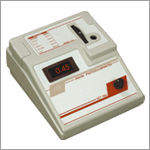
Equipment Materials : ABS Plastic, Metal
Model No : 312, 313, 321, 322
Automation Grade : SemiAutomatic
Accuracy : 100 %
Feature : Highly Efficient
Usage : Laboratory
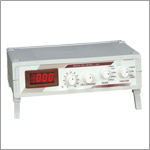
Equipment Materials : ABS Plastic
Model No : 651
Automation Grade : Manual
Accuracy : 100 %
Feature : Highly Efficient
Usage : Laboratory

Equipment Materials : ABS Plastic Body
Model No : 1312
Automation Grade : SemiAutomatic
Accuracy : 100 %
Feature : Highly Efficient
Usage : Laboratory
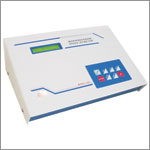
Equipment Materials : ABS Plastic
Model No : 1801
Automation Grade : Automatic
Accuracy : 100 %
Feature : Highly Efficient
Usage : Laboratory
|


 |
SINGHLA SCIENTIFIC INDUSTRIES
All Rights Reserved.(Terms of Use) Developed and Managed by Infocom Network Private Limited. |

 Send Inquiry

 Send Inquiry