About Vacuum Tissue Processor
Vacuum Tissue Processor at a Glance
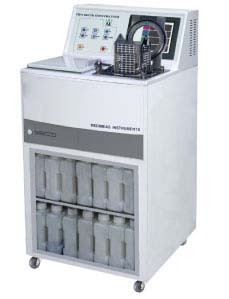
Simultaneous processing of upto 200 cassettes.
High quality specimen.
Fully automatic reagent management system.
Comprehensive monitoring and full process control.
Eight programs that consist of upto 9 reagent and 3 paraffin wax steps.
Large color LCD display.
One touch start of pre saved programs.
Automatic / Manual running modes.
Auto cleaning cycle.
Low reagent alarm.
Easy, cleaning and maintenance.
Technical Specifications : -
| Specifications | SSI/VE/SERIES | SSI/122 |
| Operation | Moving tissue type | Moving reagent type |
| Maximum capacity | 50-80 Cassettes | 200 Cassettes |
| Processing volume | 1/2 ltr (Beaker Vol.) | 5.3 ltr (Beaker Vol.) |
| Temperature (Paraffin) | 45-85 deg C | ambient - 99 deg C |
| Processing time (each step) | 99 hrs. 59 mins. | 99 hrs. 59 mins. |
| Number of programs | 8 | 8 |
| Weight | 80kg | 100kg |
| Paraffin Baths | | |
| No. of Baths | 2 (Optional-3) | 3 |
| Volume | 1/2 Liters | 4 ltrs each |
| | | |
| Reagent Stations | | |
| Number | 10 Beakers | 9 Bottles |
| Volume | 1/2 Liters | 4 ltrs each |
With the capability to process up to 100 tissue cassettes in one batch and featuring 12 individual stations, the VTP-100 streamlines routine histopathology procedures. Digital programmable controls ensure precise timing and temperature regulation, supporting reproducible and accurate specimen preparation.
Safety and User-Friendly OperationUser safety is prioritized with overheating protection, automatic shutdown, and audible alarms. The microprocessor-controlled system and intuitive touch keypad interface make operation simple for laboratory personnel, while the digital display provides real-time monitoring of all parameters.
Robust Construction and Versatile ApplicationCrafted from durable mild steel, high-grade plastic, and glass, the VTP-100s robust design withstands daily laboratory demands. The processors compact benchtop profile makes it suitable for diverse laboratory settings, and its built-in exhaust port ensures a safer, odor-controlled environment.
FAQs of Vacuum Tissue Processor:
Q: How does the Vacuum Tissue Processor improve laboratory workflow?
A: By automating tissue processing for up to 100 cassettes per batch, the VTP-100 significantly reduces manual intervention and processing time, enhancing consistency and allowing staff to focus on critical analyses.
Q: What types of samples can be processed using this equipment?
A: The VTP-100 is specifically designed for histopathology tissue specimens, making it ideal for both clinical diagnosis and research settings in pathology laboratories.
Q: When should the built-in safety features be used?
A: Safety featuressuch as overheating protection, audible alarms, and automatic shutdownare automatically engaged whenever unsafe operating conditions are detected, ensuring operability and specimen integrity throughout every process cycle.
Q: Where can the Vacuum Tissue Processor be installed?
A: Its benchtop mount and compact dimensions (670 x 470 x 430 mm) allow installation in various laboratory environments, requiring only standard electrical power (220-240V AC) and minimal bench space.
Q: What is the process of tissue processing using this model?
A: Tissue samples placed in cassettes move sequentially through reagent and wax stations. The digital vacuum regulation and programmable timer enable precise dehydration, clearing, and impregnation steps for high-quality tissue preservation.
Q: How can users operate and monitor the instrument?
A: Users interact with the VTP-100 via a touch keypad and monitor operations on the digital display with LED indicators, easily setting process parameters and receiving real-time feedback and alerts.
Q: What are the benefits of the digital vacuum control and exhaust port?
A: Digital vacuum regulation allows consistent processing conditions, improving specimen quality, while the integrated exhaust port helps remove hazardous fumes, creating a safer and cleaner working environment.








 Send Inquiry

 Send Inquiry