About System to Study Free Fall, Optical Gates
System to Study Free Fall, Optical Gates
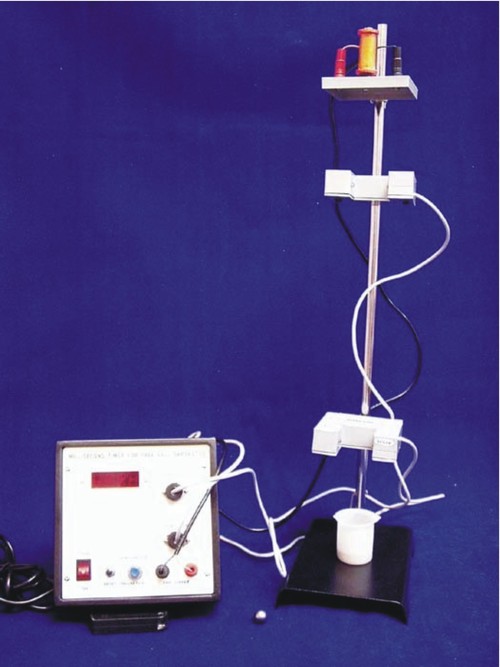
This easy to operate system is designed to demonstrate uniform acceleration due to gravity and its accurate determination and to demonstrate conservation of mechanical energy and for accurate determination of acceleration due to gravity g.
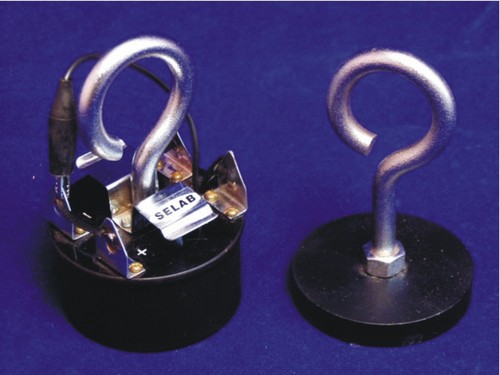
Components: Supports (1.80m height), electromagnet to hold the ball, 2 highly sensitive photo-optical gates, graduated ruler (1.50m length), ball receptacle, stable metal base, 3 screws to adjust the support in the vertical plane.
Principle: The electromagnet holds the steel ball at the top of the support. When you press the button on the control box the ball falls down. During the motion the ball triggers the start and stop of the digital chronometer when it crosses upper and lower optical gate respectively. Supplied with chronometer & Electromagnetic Control Box and instruction manual.Highly Accurate Free Fall MeasurementsThis system utilizes precision electronics and a digital LED display to capture fall times with 100%% accuracy and millisecond resolution. The infrared light gates trigger instant timing as the ball passes, allowing consistent calculation of gravitational acceleration in controlled experiments.
Flexible Experiment ConfigurationGate spacing between 20cm and 100cm can be easily adjusted to vary the height of free fall studies. The electromagnetic release mechanism ensures repeatable ball drops, and the desktop/benchtop mounting provides stability during use. Included accessories streamline setup for quick experimentation.
Durable and Portable DesignCrafted from high-quality plastic and metal components, the apparatus is both robust and lightweight (approx. 2-3 kg). Its compact dimensions make it simple to transport within laboratory environments, while the 1-meter cable set offers convenient placement of gates and controls.
FAQs of System to Study Free Fall, Optical Gates:
Q: How does the ball release and timing process work in this system?
A: The system uses an electromagnetic release device to drop the ball, ensuring precise starting conditions. Infrared optical gates detect the ball as it falls, triggering the digital timer with millisecond precision, allowing accurate measurement of free fall time.
Q: What experiments can be conducted with the System to Study Free Fall, Optical Gates?
A: This apparatus is designed for time-of-free-fall experiments, enabling calculation of acceleration due to gravity. Its commonly used in physics education and research to study free fall dynamics under controlled laboratory conditions.
Q: When is it suitable to use this equipment?
A: Use this system in indoor, dry laboratory settings at room or ambient temperature. Its ideal for academic institutions, research laboratories, and classroom demonstrations requiring accurate, repeatable gravitational measurements.
Q: Where can the system be mounted and set up?
A: The system can be installed on a desktop or benchtop, thanks to its compact frame and portable design. The 1-meter cable length between optical gates and control unit allows flexible arrangement to suit different experiment setups.
Q: What are the main components included with the system?
A: Core components include optical infrared light gates, a digital LED display timer, cable set, test stand, electromagnetic ball release mechanism, test ball, power adapter, and user manual.
Q: How is precision and accuracy ensured during measurements?
A: Millisecond timing, infrared gates, and a stable ball release deliver consistent readings with 100%% accuracy. Adjustable gate spacing and reliable electronics further minimize experimental errors.
Q: What benefits does this system offer compared to manual timing methods?
A: This semi-automatic system provides superior measurement precision, eliminates human error in timing, and offers quick, repeatable experiments with clear digital results, enhancing the reliability of physics investigations.









 Send Inquiry

 Send Inquiry