About Optical Bench
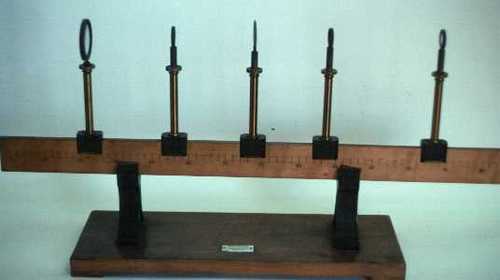
The optical bench is commonly used in physics labs today, and consists of a long, rigid member with a linear scale applied to it. Holders for light sources, lenses and screens are placed on the apparatus so that image formation can be observed. Versatile Holder ConfigurationChoose between three to five adjustable holders for flexible arrangement of lenses, mirrors, and other optical elements. The spring-loaded clamps provide secure, easy attachment and repositioning during experiments, supporting diverse setups without risking component stability.
Precision Measurement and ConstructionConstructed using a rigid stainless steel rod and durable cast iron supports, this optical bench features a graduated scale at 1 mm intervals. The brass clamps and factory calibration ensure measurement accuracy and repeatable results, essential for scientific experimentation.
Easy Portability and CustomizationWith its modular design, the bench is quickly assembled or dismantled, facilitating transport and storage. Standard length is 1 meter, with options to extend up to 2 meters, accommodating a wide variety of experimental configurations in classroom or laboratory environments.
FAQs of Optical Bench:
Q: How do I assemble and dismantle the optical bench for portability?
A: The optical bench is designed with a modular rod and spring-loaded clamps, allowing you to easily attach and detach components. Simply unlock the holders and supports, remove the clamps, and pack the parts in the supplied export packaging for safe transport or storage.
Q: What types of lenses and mirrors are supported by the bench?
A: The bench accommodates lenses and mirrors with diameters ranging from 30 mm to 75 mm. The adjustable holders and spring-loaded clamps securely position these components, enabling precise alignment for various optical experiments.
Q: When should I use this optical bench in physics experiments?
A: This optical bench is ideal whenever you need to demonstrate or investigate optical principles, such as reflection, refraction, or focal length determination in educational laboratory settings. It suits both introductory and advanced physics activities.
Q: Where can the optical bench be effectively used?
A: The bench is suitable for use in physics laboratories, research facilities, and classrooms. Its sturdy, portable form factor makes it practical for both permanent installations and mobile educational setups.
Q: What is the process for calibrating the bench before use?
A: There is no user calibration required, as the bench is factory calibrated for immediate accuracy. The millimeter graduation scale and secure mounting system ensure precise initial measurements, streamlining setup before experiments.
Q: What are the benefits of using spring-loaded clamps on this bench?
A: Spring-loaded clamps provide firm support for optical components while allowing quick adjustments without tools. This design prevents accidental movement or misalignment, thus maintaining measurement fidelity during experiments.
Q: How does the graduated scale contribute to experimental accuracy?
A: The 1 mm interval scale enables precise positioning and measurement of objects along the bench, supporting accurate data collection and analysis in optical experiments. This reduces the chance of error and enhances the reliability of results.










 Send Inquiry

 Send Inquiry