About Mechanical Equivalent of Heat
Mechanical Equivalent of Heat
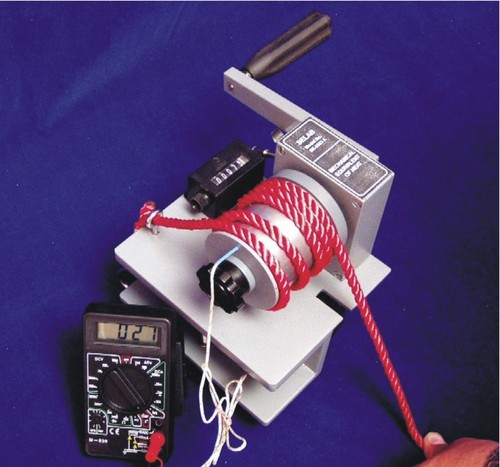
This Apparatus provides an update version of one of the Joules most important experiments, converting mechanical work into thermal energy and determination of the relationship between mechanical work done and units of heat energy. It includes a base, cylinder, crank and counter with a built-in table clamp, 2.5 meters of nylon rope, 5kg of laboratory masses. Complete with instruction manual.
Features:
Easy to use with Accuracy of 5%%.
Rugged Ball Bearing Construction.
Thermoelectric probe Directly give temperature readings. No Thermometers to Break.
Double Ball Bearings - Minimize the wear of moving parts and enhances the life of apparatus.
Counter: Counts and displays the number of rotations. One cannot forget how many times he has cranked.
How It Works: A nylon rope is wrapped several times around the aluminium cylinder. Rotation of the crank performs a measurable amount of work. This in turn, rotates the cylinder. With the rotation of the crank, the friction between the rope and the aluminium cylinder is just enough to support a mass hanging at the other end of the rope ensuring that the torque acting on the cylinder is constant and measurable. A counter keeps track of the number of rotations. The work done in rotating the cylinder is converted into thermal energy due to the friction between the cylinder and the rope. This results in rise in the temperature of the cylinder, which can be noted by using the thermoelectric probe & digital multimeter. The ratio between the work done and the thermal energy produced and transmitted to the cylinder determines J, the mechanical equivalent of heat. With this apparatus, the value of J can be determined to an accuracy of within 5%%. Accurate Laboratory ExperimentationThis apparatus offers outstanding accuracy for exploring the mechanical equivalent of heat through the direct conversion of mechanical energy into thermal energy using friction. Equipped with a precision-engineered spindle, a high-efficiency stirring mechanism, and an insulated calorimeter, it is ideal for both teaching laboratories and scientific research. Its 100%% measurement precision and wide temperature range contribute to reliable and reproducible experiments.
User-Friendly and Durable ConstructionConstructed with a heavy-duty metal frame, heat-resistant glass, and a brass calorimeter, the device is both robust and dependable. The powder-coated finish resists corrosion, and the anti-vibration feet ensure steady operation. The manual operation method allows for easy use without the need for electrical power or voltage supply, making it practical for diverse laboratory settings.
Compliance and Safety AssuranceSafety and quality are assured with ISO and CE certifications, and the apparatus is supplied with a calibration certificate for traceable accuracy. Each unit is packed in a strong corrugated export carton to ensure safe delivery and storage. Its design focuses on efficiency, accuracy, and reliability, meeting the standards required for modern laboratory applications.
FAQs of Mechanical Equivalent of Heat:
Q: How does the Mechanical Equivalent of Heat apparatus operate without electricity?
A: This apparatus relies on manual operation using weights and a friction-based stirring mechanism to generate heat. The energy from mechanical work is converted into heat within the calorimeter, demonstrating Joules experiment results without any need for electrical power.
Q: What procedures are involved in conducting experiments with this equipment?
A: To conduct an experiment, add water to the 1000 ml double-insulated calorimeter, place the thermometer and weights, and rotate the spindle using the pulley system. As the stirrer turns, friction generates heat, increasing the temperature, which is then recorded and analyzed according to Joules principle.
Q: When should the calibration certificate be referenced?
A: The calibration certificate should be referenced before the first use and periodically afterward to verify the apparatuss measurement accuracy. It ensures that all recorded data are valid and reliable for academic or research purposes.
Q: Where can this apparatus be used most effectively?
A: It is best suited for physics and engineering laboratories in educational institutions, research centers, or technical training facilities where the principles of energy conversion and thermodynamics need to be demonstrated or studied.
Q: What benefits does the double-layer insulation provide?
A: The robust double-layer insulation minimizes heat loss during experiments, ensuring that temperature increases are primarily due to mechanical work, thereby improving the precision of your results and the apparatuss efficiency.
Q: How do anti-vibration feet assist during experiments?
A: Anti-vibration rubber feet stabilize the apparatus during use, reducing external movement and ensuring more accurate temperature and energy readings as they minimize disturbances during critical measurements.








 Send Inquiry

 Send Inquiry