About KIPPS APPARATUS
| KIPPS APPARATUS |
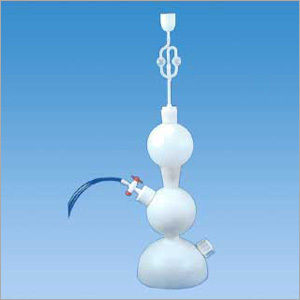
| Polylab kipps apparatus made of Polyethylene has three main porrions. The top portion is fitted with a thistle funnel and a bulb structure through which dilute acid can be poured which reacts with a metal sulphide in the base of the apparatus. H2S gas then envolved collects in the middle dome from where it can be released through a leakproof stopcock fitted with a self lubricating PTFE plug. The base is provided with a residual outlet fitted with a cap for easy cleaning
Material : High Density Polythylene | CODE NO. | PARTICULARS | PACKING (Pcs) | | 55501 | Kipp's Apparatus 250 ml | 1 | | 55502 | Kipp's Apparatus 500 ml | 1 | | 55503 | Kipp's Apparatus 1000 ml | 1 | |
Versatile Laboratory Gas GenerationThe Kipps Apparatus serves as an essential gas generation tool in educational and research laboratories. Designed for manual operation, it allows users to generate gases like H2S or CO2 safely and conveniently, without the need for power sources. The transparent, clear borosilicate glass construction provides clear visibility and outstanding thermal resistance, making it reliable for repetitive laboratory use.
Manual Operation for Controlled OutputWith its batch-mode operation and manual reagent addition, this apparatus offers users precise control over gas production. The inclusion of a side glass nozzle equipped with a stopcock enables accurate gas release, minimizing risks and ensuring safer handling during experiments. Its chemical compatibility supports a range of acids and sulfides commonly used in gas generation.
Durable and Adaptable DesignBuilt using high-grade borosilicate glass and featuring rubber and durable plastic components, the Kipps Apparatus delivers longevity and resistance to corrosion by most chemicals. Available in different sizes (500 mL, 1000 mL, 2000 mL), it can accommodate a variety of experimental scales, making it a flexible choice for laboratories in India.
FAQs of KIPPS APPARATUS:
Q: How does a Kipps Apparatus function for gas generation in the laboratory?
A: A Kipps Apparatus generates gases through a manual batch process that involves adding specific reagentstypically acids and sulfidesinto its three designated chambers. The chemical reaction takes place in the middle chamber, releasing gas, which is then collected and directed through the side glass nozzle fitted with a stopcock for controlled output.
Q: What gases can I produce using a Kipps Apparatus, and which chemicals are compatible with it?
A: The Kipps Apparatus is commonly used to generate gases such as hydrogen sulfide (H2S) and carbon dioxide (CO2). It is compatible with a variety of acids and sulfides, owing to its borosilicate glass construction and chemical-resistant components, making it suitable for diverse laboratory reactions.
Q: When is it appropriate to use the manual stopcock on the gas outlet during operation?
A: You should use the manual stopcock control whenever you need to regulate or cease the flow of generated gas. This feature ensures precise management of gas output during experiments and helps maintain safety when collecting or stopping the release of reactive gases.
Q: Where should the Kipps Apparatus be installed or positioned for optimal safety and performance?
A: For optimal safety, place the Kipps Apparatus in a well-ventilated fume hood or designated laboratory work area. This setup ensures safe dispersal of any accidental gas leaks and allows users to work comfortably with hazardous chemicals.
Q: What is the general process involved in assembling and operating this apparatus?
A: To operate, start by assembling all componentsattach the chambers and secure with rubber stoppers as needed. Introduce appropriate reagents to the upper and lower chambers, ensuring chemicals are handled properly. Gas generation occurs in the middle chamber, and the resulting gas can be collected or transferred via the side nozzle using the stopcock.
Q: How can users benefit from using the Kipps Apparatus in laboratory gas generation?
A: This apparatus offers several advantages: it allows safe, on-demand generation of laboratory gases without the need for electricity, features durable and chemically-resistant borosilicate glass for longevity, and provides precise manual control of gas flow, improving experiment accuracy and laboratory safety.









 Send Inquiry

 Send Inquiry