About FORCE ON A CONDUCTOR BALANCE
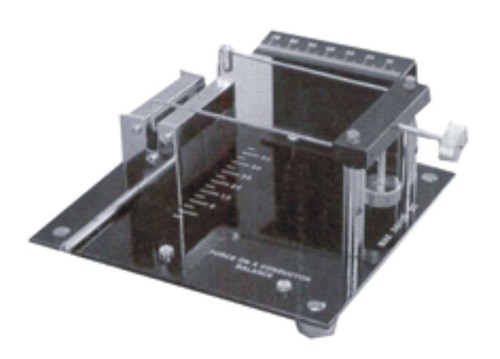
Also called Current balance. For demonstration of the relationship between force acting on a current carrying a conductor in a magnetic field. Two metal pillars mounted on an insulated base, each with a 4mm hole for electrical connecting. Conducting arms, consisting of a metal wire shaped into a rectangular L-loop, are mounted on a balance beam, which is supported on the pillar by two conical bearings that act as fulcrum. Two screwed masses are attached to the beam, one horizontally, for adjusting the equilibrium position of the arms, and the other vertically for adjusting the sensitivity. One conducting arm current a rider, which adjust equilibrium with the current flowing by sliding along a scale graduated 0-75 X 1mm. the bend at the end of the conducting arms oscillators vertically in the magnetic field produced by a compound magnet, comprising five identical, horseshoe magnets mounted in the frame. The magnets can slide along a rod mounted on the base with a 6cm scale, giving the length of arms in the magnetic field. Precision Measurement and EfficiencyThis apparatus is designed for highly sensitive force measurements on copper conductors within a magnetic field strength up to 0.2 Tesla. Its precision screw adjustment mechanism and finely graduated scale ensure reliable, reproducible results. The inclusion of a factory calibration and overload protection boosts operational confidence while enabling accurate and efficient demonstrations.
Robust Build and User-Friendly DesignConstructed using a durable non-magnetic metal frame with a sleek silver and black powder-coated finish, the equipment combines longevity with aesthetic appeal. Essential accessories like a user manual, power cord, and connecting leads are provided to facilitate effortless setup and operation.
Safe and Compliant OperationWith IS 9001 certification, insulation resistance greater than 100 M, and a maximum test voltage of 250V, this apparatus upholds rigorous safety standards. Overload protection safeguards the equipment during high-current experiments, supporting up to 5A currents and ensuring user and device safety.
FAQs of FORCE ON A CONDUCTOR BALANCE:
Q: How is the FORCE ON A CONDUCTOR BALANCE apparatus used for electromagnetic demonstrations?
A: The apparatus allows you to measure the force exerted on a copper rod by adjusting the current (up to 5 Amps) flowing in the conductor while it is exposed to a magnetic field up to 0.2 Tesla. Observations are made using the precise scale, facilitating vivid demonstrations of electromagnetic force principles in a laboratory setting.
Q: What safety features are included in the FOAB-01 model?
A: The apparatus incorporates overload protection to prevent damage during high-current tests, and all components are factory calibrated. It also maintains insulation resistance greater than 100 M and complies with IS 9001 standards for safe laboratory use.
Q: When should recalibration of the system be considered?
A: Though the system is factory calibrated, recalibration may be recommended after extensive use, following significant transportation, or annually to maintain the highest measurement accuracy. Refer to the user manual for detailed recalibration procedures.
Q: Where can the FORCE ON A CONDUCTOR BALANCE be used?
A: This apparatus is best suited for laboratory environments, educational institutions, and research facilities in India where controlled demonstrations of electromagnetic force on conductors are required. Its tabletop mounting and efficient design support versatile application.
Q: What is the process for setting up the equipment for measurements?
A: Place the apparatus on a stable tabletop, connect the supplied power cord, and attach the conductor using the provided leads. Adjust the current through the copper rod and configure the precision screw mechanism for calibration before taking measurements as per the user manual instructions.
Q: How does the apparatus benefit laboratory demonstrations?
A: Its high sensitivity, accurate readings (with scale graduations of 10 mg), overload protection, and robust construction make it ideal for reliably illustrating electromagnetic force principles. The highly efficient system saves time and enhances experimental clarity for both students and researchers.









 Send Inquiry

 Send Inquiry