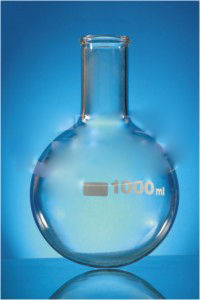
About Flask Round Bottom
| Flask Round Bottom |
| Flask Round Bottom wide neck, with beaded rim DIN 12347, ISO 1773 | | | | Capacity (ml) | D. (mm) | D1. (mm) | H. (mm) |
| | | | | | | | | | | | | | | | | | | | | | | | |
|
|
Superior Material and ConstructionMade from high-quality borosilicate glass, this round bottom flask offers excellent chemical and thermal resistance, withstanding temperatures up to 500C. Its uniform wall thickness and transparent finish ensure enhanced safety and easy monitoring during laboratory experiments. The flasks durable construction meets laboratory grade standards, making it a reliable choice for repeated use.
Versatile Laboratory UseDesigned for a variety of laboratory applications, the round bottom flask is perfect for heating, boiling, and mixing chemicals. Its compatibility with laboratory stands, heating mantles, and Bunsen burners provides flexibility in experimental setups. The option of single or multiple neck configurations extends its utility across numerous scientific procedures.
FAQs of Flask Round Bottom:
Q: How should the round bottom flask be used safely in laboratory experiments?
A: To use the round bottom flask safely, always ensure it is correctly supported on a laboratory stand or held in place with clamps. When heating, use a heating mantle or Bunsen burner, making sure the flask is gradually brought to the desired temperature to prevent thermal shock.
Q: What types of chemicals can the flask withstand, and does it resist thermal stress?
A: The flask is made from borosilicate glass, offering excellent resistance to a broad range of chemicals and thermal stress. It can safely handle temperatures up to 500C, making it suitable for most laboratory heating and boiling applications.
Q: When is it appropriate to use a single neck versus a multiple neck flask?
A: A single neck flask is ideal for straightforward heating or boiling tasks, while multiple neck flasks are preferred when you need access for adding reagents, measuring, or inserting laboratory instruments during complex procedures.
Q: Where can these flasks be utilized within laboratory setups?
A: These round bottom flasks are suitable for use in research laboratories, educational institutions, chemical industries, and any scientific settings requiring precise and safe chemical handling and heating.
Q: What is the cleaning and maintenance process for the round bottom flask?
A: After each use, thoroughly rinse the flask with appropriate cleaning agents and water. It is autoclavable, so it can be sterilized in an autoclave for reuse. Ensure it is completely dry before storage to avoid contamination or glass corrosion.
Q: What are the benefits of choosing a borosilicate glass round bottom flask?
A: Borosilicate glass provides high chemical and thermal resistance, durability, optical clarity, and uniform wall thickness. This makes the flask reusable, easy to clean, and safe for rigorous laboratory applications.










 Send Inquiry

 Send Inquiry