About Erlenmeyer Flasks
| Erlenmeyer Flasks |
| Erlenmeyer Flasks, Narrow Neck with graduation DIN 12380, ISO 1773 | | | | Capacity (ml) | D. (mm) | D1. (mm) | H. (mm) |
| | | | | | | | | | | | | | | | | | | | | | | | | | | | |
|
|
|
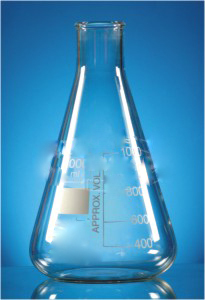
Crystal-Clear Measurement and CompatibilityThe white ceramic graduation markings on these Erlenmeyer flasks offer sharp contrast, allowing for easy and accurate solution measurement. Their compatibility with standard rubber and cork stoppers guarantees versatility for storage and experimental needs in any laboratory setting. Choose the size that fits your application, knowing you will achieve reliable performance every time.
Robust Borosilicate Glass ConstructionMade from borosilicate glass, these flasks provide excellent chemical and thermal resistance, supporting repeated use involving heating, mixing, or storing volatile and non-volatile solutions. With their autoclavable and dishwasher-safe properties, cleaning and sterilizing is simple and efficient, ensuring long-term, safe use in research, education, and quality control laboratories.
Broad Application in Laboratory WorkWhether for educational demonstrations or quality control testing, these Erlenmeyer flasks excel across various laboratory disciplines. Their conical shape and clear graduations make them ideal for mixing reagents, heating samples on hot plates or open flames, and precisely measuring solutions, making them essential equipment for any lab professional or student.
FAQs of Erlenmeyer Flasks:
Q: How do the white ceramic graduation markings aid in laboratory work?
A: The white ceramic graduation markings on the Erlenmeyer flask ensure easy-to-read and precise estimation of liquid volumes, enhancing accuracy during preparation, measurement, and mixing of solutions in laboratory environments.
Q: What types of stoppers are compatible with these flasks?
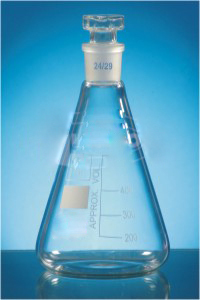
A: These Erlenmeyer flasks are compatible with standard rubber and cork stoppers, allowing secure sealing for storage, transportation, or controlled reactions involving volatile or sensitive solutions.
Q: When is it safe to heat these flasks directly?
A: Thanks to robust borosilicate glass construction, these flasks can be safely heated directly on hot plates or over open flames. They resist thermal shock and withstand temperatures up to 400C, suitable for most laboratory heating processes.
Q: Where are these Erlenmeyer flasks typically used?
A: The flasks are a staple in research, educational, and quality control laboratories across India and worldwide, supporting diverse applications such as solution preparation, chemical reactions, and sample heating.
Q: What is the cleaning process for these flasks?
A: These flasks are both autoclavable and dishwasher safe, allowing for convenient and thorough cleaning. For sterilization, simply place them in an autoclave or dishwasher following standard laboratory protocols.
Q: What benefits do borosilicate glass flasks offer compared to regular glass?
A: Borosilicate glass offers superior resistance to chemicals, thermal shock, and mechanical stress, making these flasks durable and reusable for a variety of laboratory applications involving harsh conditions.
Q: How accurate are the volume measurements on these flasks?
A: The graduated markings on these flasks are calibrated for approximate measurements, making them suitable for general laboratory use where precise titration-level accuracy is not required.








 Send Inquiry

 Send Inquiry