About DESICCATOR (VACUUM)
| DESICCATOR (VACUUM) |
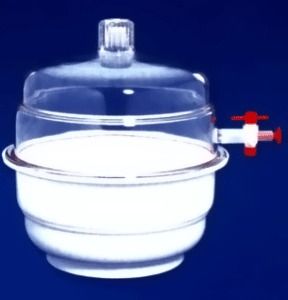
| Polylab Desiccators are made of Polypropylene and Polycarbonate. These autoclavable vacuum desiccators can hold vacuum upto 740mm of Hg for 24 Hrs. Without any greasing. The top dome, moulded in rigid and transparent Polycarbonate, gives a crystal clear view of the desiccant placed inside. The knurled knob on the top provides easy handling of the dome. The lower part is made of Polypropylene. An internal groove is provided on the flange to hold a silicon rubber O-Ring. The polypropylene stopcock is fitted with a self lubricating PTFE plug. This plug works three way i.e. Vacuum creation, shutting off & vacuum releasing.
Material : Polypropylene / Polycarbonate | CODE NO. | PARTICULARS | PACKING (Pcs) | | 55204 | Desiccator (Vaccum) PP/PC 150 mm | 1 | | 55205 | Desiccator (Vaccum) PP/PC 200 mm | 1 | | 55206 | Desiccator (Vaccum) PP/PC 250 mm | 1 | | 55207 | Desiccator (Vaccum) PP/PC 300 mm | 1 | |
Superior Air-Tight ProtectionDesigned for hassle-free laboratory usage, this vacuum desiccator utilizes a silicon or neoprene gasket, ensuring an optimal air-tight seal without the need for sealing grease. This guarantees maximal protection for sensitive materials against humidity and contaminants, making it ideal for long-term storage and drying applications.
High Chemical and Thermal ResistanceConstructed with inert, chemical-resistant materials such as borosilicate glass or high-grade plastics, the desiccator is compatible with a wide spectrum of laboratory desiccants. Its design withstands temperatures up to 120C, allowing safe usage in various laboratory conditions while ensuring consistent performance over repeated use cycles.
User-Centric, Portable DesignThe vacuum desiccators lightweight and ergonomic construction offers easy handling and transport around the laboratory. Its transparent lid with a sturdy knob allows clear visibility and effortless access, while the grease-free closure and manual control enhance operational convenience.
FAQs of DESICCATOR (VACUUM):
Q: How do I use the vacuum desiccator for drying laboratory samples?
A: To use the vacuum desiccator, place your sample on the perforated base plate, add an appropriate desiccant at the base, and position the transparent lid securely to ensure the silicon or neoprene gasket forms an air-tight seal. Connect a vacuum source to the fitted valve and evacuate air to achieve the desired vacuum. The design supports manual control and efficient drying of samples without moisture or contamination.
Q: What makes this desiccator suitable for handling chemicals and laboratory environments?
A: This vacuum desiccator is constructed from high-quality, chemical-resistant materials such as borosilicate glass and specialized plastics. Its inert base plate and durable gasket prevent chemical interaction, while compatibility with various desiccants and ISO/CE certification underpin its reliability and safety in laboratory workflows.
Q: When should a vacuum desiccator be used instead of a standard desiccator?
A: A vacuum desiccator is ideal when your application requires the removal of moisture at reduced pressure, accelerating drying or protecting highly hygroscopic materials from ambient humidity. Use this device when gentle yet thorough moisture exclusion is necessary, or for storage of samples sensitive to air and moisture.
Q: Where can this vacuum desiccator be typically employed?
A: This laboratory-grade vacuum desiccator is widely used in research laboratories, educational institutions, pharmaceutical environments, and quality control labs across India and abroad. Its portability and compatibility with standard laboratory sizes ensure seamless integration with existing laboratory equipment.
Q: What is the benefit of the transparent lid and robust knob design?
A: The transparent lid allows users to monitor samples without disturbing the sealed environment, maintaining vacuum integrity. The sturdy, ergonomic knob ensures safe and effortless opening and closing, reducing the risk of sample disturbance and providing enhanced user convenience.
Q: How do I ensure an air-tight and grease-free seal?
A: This desiccator features a specially designed silicon or neoprene sealing gasket that provides a reliable, air-tight seal without the need for sealing grease. To maintain optimal vacuum conditions, always check that the gasket and lid are clean and properly aligned before each use.








 Send Inquiry

 Send Inquiry