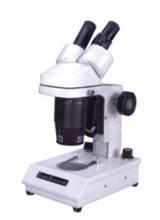
About Advance Stereo Microscopes
Advance Stereo Microscope
Features: -
ü Binocular head inclined at 450
ü Paired 10x WIDE FIELD EYE PIECE
ü Choice of objectives combination of either 2x and 4x or 3x and 5x
ü Rack & Pinion focus control with slip clutch protection & positive stops
ü Control knob on base allows selection of incident, transmitted or simultaneous lighting.
ü Rectangular stage with 75 mm diameter frosted glass insert.
Supplied in a wooden storing cabinet.
Specification: -
Cat No. ---- 127
Stand ---- Dual light, stable stand
Eye tube ---- 45o inclined binocular head
Objectives ---- Paired 2x-4x or 3x resolving on turret mount with quick indexing
Illumination ---- Incident light 6V-25W auto bulb and transmitted light 6V-25W auto bulb
Focus ---- Focussing knob on stage
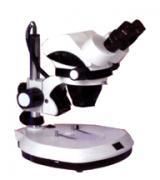
Dual LED Illumination Offers Versatile LightingExperience the convenience of both top and bottom LED illumination, providing optimal lighting conditions for a variety of sample types. Adjustable brightness levels give users precise control when inspecting biological or industrial specimens, ensuring clarity and enhancing detail visibility. The lighting system is efficient, stable, and compatible with both AC 220V and 110V supplies.
Robust Build and High-Performance OpticsBenefit from sturdy, anti-rust coated metal construction designed for long-lasting use in demanding environments. The wide field of view, paired with WF10x and WF20x eyepieces and dual objectives, delivers up to 40x magnification and high accuracy up to 0.01 mm resolution. The frosted glass and contrast stage plates further enhance versatility across applications.
Designed for User Comfort and FlexibilityThe ergonomic 360 rotatable head, adjustable interpupillary distance (5575 mm), and coarse focus adjustment make prolonged observation sessions comfortable and precise. With a working distance of 60mm and support for samples up to 50mm thick, this microscope adapts to a wide range of research, teaching, and industrial tasks.
FAQs of Advance Stereo Microscopes:
Q: How do I adjust the illumination intensity on the Advance Stereo Microscope?
A: The microscope features adjustable top and bottom LED illumination. Simply use the designated brightness control knobs to increase or decrease the intensity according to your observation needs. This allows clear visualization of both transparent and opaque samples.
Q: What is the process for switching between different magnifications?
A: To change magnification, select the desired eyepiece (WF10x or WF20x) and rotate the objective turret between the paired 2x and 4x objectives. This combination allows you to achieve zoom or fixed magnification settings up to a maximum of 40x.
Q: When is it beneficial to use the frosted glass stage plate versus the black/white contrast plate?
A: The frosted glass plate is ideal for transmitted light with transparent specimens when using bottom illumination, while the black/white contrast plate enhances visibility of opaque specimens with top lighting by improving contrast against the sample.
Q: Where can this microscope be effectively utilized?
A: This model is suitable for laboratories, research institutions, educational settings, and in industrial inspection environments across India. Its robust construction and flexibility make it well-suited for any professional context that requires accurate observation of samples up to 50mm thick.
Q: What are the main benefits of the 360 rotatable head and adjustable interpupillary distance?
A: The 360 head rotation allows users to comfortably share the view or reposition the microscope without moving the sample. Adjustable interpupillary distance (5575mm) ensures comfortable viewing for users with different eye spacing, minimizing eye strain during extended sessions.
Q: How does the dust-resistant housing enhance the microscopes durability?
A: The dust-resistant housing protects the microscopes internal optics and mechanical components, reducing maintenance and preserving performance, especially in environments prone to dust or particulates.
Q: What is the recommended usage process for obtaining precise measurements?
A: Start by selecting the appropriate magnification and adjust the focus with the coarse adjustment knob. Use the stage and plate appropriate for your sample type, and rely on the high-resolution optics (up to 0.01 mm accuracy) to observe fine details or measure specimen dimensions accurately.









 Send Inquiry

 Send Inquiry